DTF vs Silkscreen vs Embroidery vs DTG Printing — The Complete Guide for Penang Businesses in 2026
Not sure which printing method is right for your uniform or T-shirt order? This is the most comprehensive, honest comparison guide available — covering every major technique used by uniform suppliers and T-shirt printers in Penang today.
When you place a uniform or T-shirt printing order, one of the most important decisions you will make is not the colour, not the brand, and not even the design — it is the printing method. Choose the wrong technique and your logo might crack after ten washes, look washed out on the garment, cost far more than necessary, or simply not be achievable at the quantity you need.
With four major printing methods in active use across Penang's uniform and custom apparel industry — DTF, silkscreen, embroidery, and DTG — the differences between them are significant. Each has its own strengths, limitations, ideal use cases, and cost profile. Understanding how they work and where each one excels will save you money, prevent disappointment, and ensure your finished uniforms look exactly the way your brand deserves.
This guide is written by the team at UniformPenang.com — a full-service uniform supplier and printing company serving businesses across George Town, Bayan Baru, Bayan Lepas, Air Itam, Butterworth, Bukit Mertajam, Batu Kawan, and the entire Penang region. We use all four of these methods regularly and will give you a straight, unbiased breakdown of exactly when to use each one.
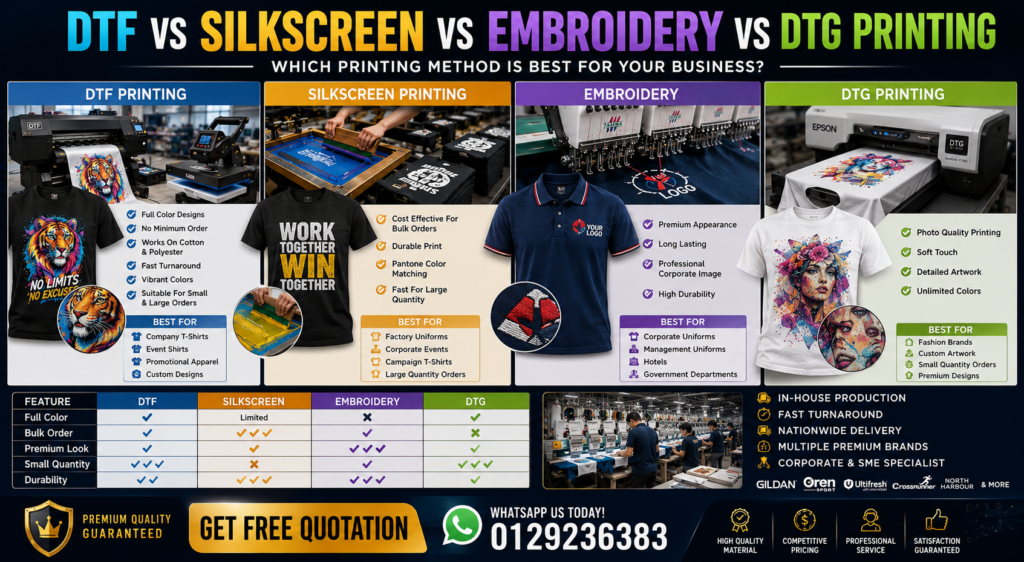
Quick Overview — Four Printing Methods at a Glance
Direct-to-Film heat transfer. Full colour, no MOQ, works on any fabric. Best for complex logos and small orders.
Ink pushed through mesh stencil. Economical for large quantities with simple, spot-colour designs.
Thread stitched directly into fabric. Raised, tactile finish that communicates quality and durability.
Direct-to-Garment inkjet printing. Photo-quality results on 100% cotton. Ideal for creative and retail apparel.
Full Comparison Table — DTF vs Silkscreen vs Embroidery vs DTG
| Feature | DTF Printing | Silkscreen | Embroidery | DTG Printing |
|---|---|---|---|---|
| Minimum order | 1 piece | 24 pcs+ | 12 pcs+ | 1 piece |
| Colour capability | Unlimited / full colour | Limited (spot colours) | Thread colour-based | Unlimited / full colour |
| Fabric compatibility | All fabric types | Most fabrics | All fabric types | 100% cotton only (best) |
| Durability | Very High | High | Excellent (permanent) | Medium (fades over time) |
| Detail & complexity | Excellent (photographic) | Limited (simple shapes) | Good (medium detail) | Excellent (photographic) |
| Finish feel | Slight raised surface | Flat, smooth | Raised, textured, premium | Soft, almost no texture |
| Setup cost | Low | Medium (screen setup) | Medium (digitising fee) | Low |
| Cost for small orders | Low | High (setup amortised) | Medium | Low |
| Cost for large orders | Medium | Very Low | Medium-High | Medium-High |
| Gradient / photo support | Yes | No | No | Yes |
| White ink on dark fabric | Yes | Yes (extra cost) | Yes (white thread) | Yes (pretreat required) |
| Wash fastness | Very good | Good | Excellent | Moderate |
| Turnaround speed | Fast | Medium (screen prep) | Medium | Fast |
| Best for uniforms? | ★★★★★ | ★★★★☆ | ★★★★★ | ★★★☆☆ |
DTF Printing — Explained in Full
🎯 DTF (Direct-to-Film) Printing
DTF printing is currently the fastest-growing printing technique in Malaysia's uniform and custom apparel industry — and for very good reason. The process works by printing a design onto a special PET film using a digital inkjet printer, applying a hot-melt adhesive powder to the wet ink, curing it with heat, and then heat-pressing the finished film transfer onto the garment.
The result is a full-colour, highly detailed print with excellent durability on virtually any fabric type — cotton, polyester, nylon, canvas, and blends included. Unlike many other methods, DTF does not require any minimum order, which makes it uniquely suitable for businesses that need professional-quality prints without committing to large quantities upfront.
For businesses in Penang ordering uniforms for the first time — a new café in Bayan Baru, a startup in George Town, a small clinic in Air Itam — DTF is almost always the recommended starting point. You can order exactly what your current team needs, with no waste and no over-ordering.
DTF printing is ideal for:
- Logos with gradients, shadows, or photographic detail
- Multi-colour designs where silkscreen setup costs would be prohibitive
- Small orders of 1–50 pieces where bulk methods are overkill
- Mixed fabric garments such as cotton-polyester blends
- Businesses that need to reorder small quantities regularly as their team grows
- Event shirts, personalised jerseys, and custom fan merchandise
✓ Advantages
- No minimum order quantity
- Full colour and gradients supported
- Works on virtually all fabric types
- High durability and wash resistance
- Fast production turnaround
- Low setup cost per design
✗ Limitations
- Slight raised surface feel (not as premium as embroidery)
- Higher per-unit cost than silkscreen for very large orders
- Not ideal for extremely large print areas on heavy fabrics
Silkscreen Printing — Explained in Full
🖨️ Silkscreen Printing
Silkscreen printing — also known as screen printing — is one of the oldest and most established printing techniques in the apparel industry. It works by pressing ink through a fine mesh screen onto the garment, with each colour requiring a separate screen. The process is highly economical at scale, producing consistent, vibrant, and durable results across large batches of identical garments.
Silkscreen printing remains the dominant technique for high-volume uniform orders across Penang's manufacturing sector — factory workwear, event T-shirts for large corporate gatherings, school sports day shirts, and volunteer committee uniforms are all commonly produced via silkscreen. When you need hundreds or thousands of identical shirts with a simple one or two-colour logo, silkscreen is almost always the most cost-effective option.
The key limitation of silkscreen is its inability to reproduce photographic complexity or fine gradients — each colour requires a separate screen setup, which makes multi-colour or detailed logo work progressively more expensive and less practical. For designs with more than three or four spot colours, DTF or DTG becomes a more economical and better-looking alternative.
Silkscreen printing is ideal for:
- Large quantity orders of 50 pieces and above where per-unit cost matters
- Simple logos with 1–3 solid spot colours
- Factory workwear, construction vests, and industrial uniforms
- School sports day shirts, house T-shirts, and event shirts in bulk
- Corporate team-building shirts and large event merchandise
- Volunteer uniforms and charity run T-shirts in high volumes
✓ Advantages
- Lowest per-unit cost at high quantities
- Vibrant, bold colours on most fabric types
- Good durability and wash fastness
- Clean, flat finish preferred for casual wear
- Industry standard for bulk uniform production
✗ Limitations
- Minimum order required (typically 24 pcs+)
- Cannot reproduce gradients or photographic detail
- Each colour adds setup cost and complexity
- Setup cost makes small orders expensive per unit
Embroidery — Explained in Full
🧵 Embroidery
Embroidery is the most traditional and premium of all garment decoration techniques. Rather than applying ink or film to the fabric surface, embroidery uses a computerised machine to stitch the design directly into the fabric using thread — producing a raised, three-dimensional finish that looks and feels distinctly premium.
For corporate polo shirts, hospitality uniforms, hotel staff shirts, and any business environment where the quality of your team's appearance directly reflects the quality of your brand, embroidery is the benchmark. An embroidered logo on a polo shirt communicates a level of craft, investment, and professionalism that no printed alternative fully replicates.
Embroidery requires an upfront digitising process — converting your logo design into a stitch file that the embroidery machine can execute. This is a one-time cost per design, and once digitised, the file can be reused for all future orders. The ongoing cost per piece for embroidery is higher than silkscreen or DTF, but for businesses where uniform quality reflects brand positioning, it is a justified and worthwhile investment.
In Penang's hospitality sector — from the beach resorts in Batu Ferringhi to boutique hotels in Tanjung Bungah and corporate offices in George Town — embroidery remains the default decoration method for front-facing uniforms. It also holds up exceptionally well to commercial laundering, maintaining its appearance even after hundreds of industrial wash cycles.
Embroidery is ideal for:
- Corporate polo shirts and collared shirts for professional environments
- Hotel, resort, and hospitality staff uniforms
- Medical clinic, dental practice, and healthcare staff shirts
- Management team uniforms where premium appearance matters
- Caps, jackets, and accessories where a raised logo is expected
- Any environment where uniforms undergo frequent commercial washing
✓ Advantages
- Premium raised, tactile finish unlike any print method
- Extremely durable — lasts the life of the garment
- Professional and prestigious appearance
- Excellent wash fastness — handles commercial laundering
- Works on all fabric types including thick materials
✗ Limitations
- Cannot reproduce photographic detail or gradients
- One-time digitising fee required per design
- Higher per-piece cost than print methods
- Fine small text can be difficult to execute cleanly
DTG Printing — Explained in Full
🖥️ DTG (Direct-to-Garment) Printing
DTG (Direct-to-Garment) printing works similarly to a standard inkjet printer — except instead of printing on paper, it prints water-based ink directly onto the surface of the garment. The result is a full-colour, photographic-quality print with a very soft hand feel and virtually no texture — the print feels almost like part of the fabric rather than sitting on top of it.
DTG delivers outstanding results on 100% cotton garments. The water-based inks bond deeply with cotton fibres, producing vibrant, detailed prints that rival the visual quality of any other technique. It is particularly popular for custom T-shirts, retail fashion apparel, fan merchandise, and creative print-on-demand products where photographic quality and a premium soft feel are priorities.
However, DTG has important limitations that make it less suitable for standard uniform production. It performs significantly less well on polyester and synthetic fabrics — the inks do not bond effectively with synthetic fibres, resulting in duller, less saturated prints that fade more quickly. This means DTG is not recommended for most standard corporate polo shirts or factory workwear, which often use polyester or poly-cotton blends for durability and moisture management.
For Penang businesses ordering uniforms, DTG is best reserved for specific creative applications — custom T-shirts in 100% cotton for retail or promotional purposes, artist merchandise, limited-edition event shirts, or applications where photographic image quality and a completely flat, soft print are the priority.
DTG printing is ideal for:
- Custom T-shirts on 100% cotton in small quantities
- Creative or artistic designs with photographic complexity
- Retail fashion T-shirts and premium branded merchandise
- Fan art, band merchandise, and limited-edition prints
- Promotional T-shirts where soft hand feel is a priority
- On-demand custom printing for individual personalised orders
✓ Advantages
- No minimum order — single piece possible
- Photographic quality full-colour output
- Extremely soft hand feel on cotton
- No setup cost per design
- Ideal for highly detailed or artistic designs
✗ Limitations
- Best only on 100% cotton — poor results on polyester
- Fades faster than DTF or embroidery over time
- Higher per-unit cost than silkscreen for bulk
- Pretreatment required for dark-coloured garments
- Not recommended for most corporate uniform fabrics
Which Method Should Your Business Choose?
Still unsure which printing technique is right for your specific order? Here is a practical decision guide based on common business scenarios in Penang.
Corporate Office Polo Shirts
Small to medium quantity, logo on chest, professional finish required.
→ EmbroideryCafé or Restaurant Uniform
Small team (5–30 pcs), colourful logo, practical fabric.
→ DTF PrintingFactory Workwear (Large Qty)
100–500+ pieces, simple company logo, cost per unit matters.
→ SilkscreenSports Jersey / All-Over Print
Polyester garment, full coverage design, permanent colour.
→ SublimationEvent T-Shirt (Large Order)
200+ pieces, 1–2 colour logo, budget conscious.
→ SilkscreenHotel / Hospitality Staff
Presentation critical, frequent washing, premium brand image.
→ EmbroideryArtistic / Creative T-Shirt
100% cotton, photographic design, soft feel priority.
→ DTG PrintingNew Business (First Order)
Small quantity, complex logo, no MOQ commitment needed.
→ DTF PrintingCost Comparison — Which Method Is Most Economical?
Cost varies significantly depending on order quantity. Here is how the four methods compare across different order sizes — from a single piece to a large bulk run.
| Order Quantity | DTF Printing | Silkscreen | Embroidery | DTG Printing |
|---|---|---|---|---|
| 1–10 pieces | ✔ Best choice | Not practical | Possible (high per unit) | ✔ Good choice |
| 11–50 pieces | ✔ Good value | Possible (higher cost) | ✔ Viable | Moderate cost |
| 51–150 pieces | Good | ✔ Competitive | Medium cost | Higher cost |
| 150–500 pieces | Moderate | ✔ Best value | Higher cost | Not recommended |
| 500+ pieces | Moderate | ✔ Lowest cost/unit | Higher cost | Not recommended |
Note: Costs are relative comparisons. Actual pricing depends on number of colours, design complexity, garment brand, and current material costs. Contact UniformPenang.com for an accurate quotation for your specific order.
What Penang Businesses Are Ordering in 2026
Based on orders processed across Penang Island and Seberang Perai — from George Town to Batu Kawan, Butterworth to Bayan Lepas, Air Itam to Bukit Mertajam — here are the most common printing method choices by industry in 2026:
| Industry in Penang | Most Popular Method | Runner-Up | Reason |
|---|---|---|---|
| Corporate offices (George Town, Tanjung Tokong) | Embroidery | DTF | Premium image for client-facing teams |
| Factories & warehouses (Bayan Lepas, Perai) | Silkscreen | Heat Transfer | High volume, simple logos, low unit cost |
| Cafés & restaurants (Bayan Baru, Jelutong) | DTF | Embroidery | Small teams, colourful logos, no MOQ |
| Hotels & resorts (Batu Ferringhi, Tanjung Bungah) | Embroidery | DTF | Presentation standards, wash durability |
| Schools & tuition centres (Air Itam, Bukit Mertajam) | Sublimation | Silkscreen | Sports jerseys, house T-shirts, polyester |
| Construction & renovation (Batu Kawan, Simpang Ampat) | Silkscreen | Heat Transfer | Safety vests, bulk workwear, simple print |
| Events & community (all Penang areas) | Silkscreen | DTF | Large quantity, budget-conscious orders |
| New businesses & startups (all areas) | DTF | Embroidery | Low MOQ, flexible, professional output |
Why Choose UniformPenang.com for Your Printing Needs?
UniformPenang.com is a full-service uniform supplier and printing company serving businesses across the entire Penang region. Unlike single-method print shops, the team has in-house capability across all major printing techniques — giving you the right method for your order rather than the only method available.
- All four major printing methods available in-house — DTF, silkscreen, embroidery, and DTG
- 15+ premium uniform brands across all price ranges and fabric types
- Free consultation to help you choose the right method and brand for your specific needs
- No minimum order for DTF printing — suitable for any business size
- Professional design assistance for clients without print-ready artwork
- Fast, reliable production turnaround with clear timeline communication
- Delivery across Penang Island, Seberang Perai, and nationwide via courier
- Serving businesses in George Town, Bayan Baru, Bayan Lepas, Air Itam, Butterworth, Bukit Mertajam, Batu Kawan, Kepala Batas, Simpang Ampat, and more
📦 Customers Outside Penang
Need uniform printing services in another state? These trusted partner platforms serve your region:
💼 Want to Resell Printing Services? Become an Online Agent
Now that you understand the printing methods inside out — imagine turning that knowledge into income. KitaPrint.co offers a complete Online Printing Agent Program for anyone in Penang or across Malaysia who wants to build a business in the printing and uniform industry without needing machines or a workshop.
- No equipment, no inventory, no physical premises required
- Take orders via WhatsApp, Instagram, or any platform you prefer
- Production, quality control, and delivery all handled for you
- Attractive agent pricing with genuine profit margins on every order
- Full training on printing methods and products for new agents
Frequently Asked Questions
Not Sure Which Method Is Right for You? Ask Us — It's Free.
Contact UniformPenang.com today and let our team help you choose the right printing method, the right brand, and the right quantity for your business — with honest advice and no pressure.
- Free consultation and printing method recommendation
- Fast quotation with transparent, honest pricing
- All four major printing methods available in-house
- 15+ premium uniform brands to choose from
- Delivery across all Penang areas and nationwide
📲 WhatsApp Us for Free Consultation