
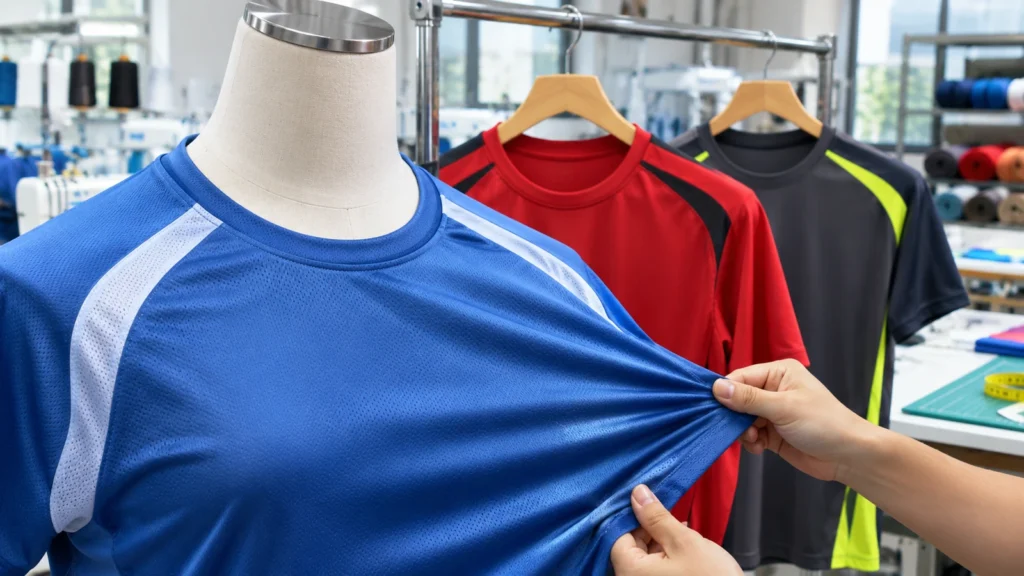
Youth and Adult Team Jerseys: Checking Neckline Fit Before Bulk Orders
One jersey design may need to fit children, teenagers and adults during the same club programme. The size labels can be misleading when collar shape and shoulder construction differ across age groups. Teams should verify the finished neckline and upper-body comfort before concentrating on player numbers or sponsor placement. The goal is to prevent a visually consistent order from becoming uncomfortable for part of the group.

Separate youth and adult size standards
Youth sizes are not miniature versions of every adult cut. Body length, shoulder width, armholes and neckline opening may grade differently. Do not extrapolate a child’s size using only chest measurements from an adult chart. Ask the supplier for the current chart of the exact garment model and identify whether youth and adult versions share fabric and collar construction.
For the purchase approval, collect one approved fitting sample from each key age or size band. This is worth recording before the design is signed off, because using a generic S/M/L label across all ages can generate unexpected exchanges.
Test the collar when putting the jersey on
A narrow neck opening may feel acceptable once worn but scrape or catch during dressing. Ask participants to put on and remove the sample naturally, especially over hair or glasses. Look for stretching recovery at the rib, pulling near shoulder seams and irritation from inner labels. The test should include the smallest and largest proposed sizes.
A useful verification step is to observe the neckline through several normal dressing cycles. The practical reason for that check is that a collar that does not recover after stretching may look loose after a few wears.
Match neck opening to sport activity
Team sports involve different ranges of motion, body contact and layering. A neckline that is too open may shift during movement, while one that is too tight can rub when the wearer turns or raises arms. The correct balance depends on cut and fabric stretch, not an arbitrary standard measurement. Try running, bending and throwing motions relevant to the activity.
During the production review, compare how the collar sits before and after a short movement trial. Skipping this step can cause a surprisingly expensive problem: a static photograph cannot show discomfort that appears only during play.
Check seams and print around the collar
Sublimation designs can place colour near the neck, but seam allowances and rib construction interrupt the printed motif. Large solid fields may make minor alignment differences obvious, while dense prints close to a stitch line can be uncomfortable if the wrong decoration method is used. Review the actual sewn sample, including inner seam finishing.
The team should also approve front, back and neckline views of the constructed garment. Treat this as part of the specification rather than an informal preference, since relying only on a flat digital mockup hides collar stretch and seam behaviour.
Collect sizes without sharing personal details
For school or club orders, use a secure list with player identification, garment model and measured size choice. Avoid public spreadsheets containing unnecessary personal information. Send one consolidated approval list to the supplier and record the cut-off date for changes. Verify spelling of names and number allocation separately from fit measurements.
Before a supplier prepares the final proof, have a second coordinator review totals and a sample of names and sizes. The risk is operational as much as visual: wrong names or duplicate numbers are not solved by having selected the right collar.
Approve both sample sizes and a wash trial
Keep representative youth and adult jerseys as reference samples. Check the neckline after washing under the garment’s instructions, and note whether it twists or changes its shape. If later reorders use a different supplier model, repeat the fitting test rather than assuming equivalent grading. A documented method makes yearly team purchasing easier.
For a repeat order, store photos plus actual measurements of the approved collars and shoulders. Keep the result with the approved sample, since an unrecorded sample can leave next year’s coordinator repeating the same fit errors.
Practical example: making the decision
A sports club orders the same jersey design for younger players, teenagers and adults. At first, the organiser proposes using adult XS for all smaller wearers, but a fitting session reveals that the neck opening and shoulder grade differ from a true youth cut. The club collects size choices from the actual garment charts and tests youth and adult samples during movement and dressing. The designer adjusts the placement of the team emblem and player number for smaller backs rather than shrinking everything equally. One coordinator signs off a list that separates names, numbers and sizes, reducing the risk of accidental duplication. After delivery, a check-off sheet matches each shirt to its player before distribution. The recorded measurements become a useful starting point for the next season, although a changed jersey model still needs fresh fitting.
Additional approval considerations
Name and size collection can easily become a privacy problem when teams exchange public spreadsheets. Share only the fields needed by coordinators and the printer, limit editing access and define when the list should be deleted or archived. Correct spelling is commercially important, but it does not require publishing unrelated player information.
Some athletes prefer a looser neckline even when the chest size fits. Provide a fitting method that allows an individual to report this problem without being pressured into an unsuitable cut. For a mixed-age order, a small number of representative samples offers better evidence than a universal instruction to order one size larger.
- Collect one approved fitting sample from each key age or size band.
- Observe the neckline through several normal dressing cycles.
- Compare how the collar sits before and after a short movement trial.
- Approve front, back and neckline views of the constructed garment.
- Have a second coordinator review totals and a sample of names and sizes.
- Store photos plus actual measurements of the approved collars and shoulders.
Frequently asked questions
Can youth sizes be estimated from adult XS?
Not reliably; use the dedicated garment chart and fitting sample.
Does a soft rib guarantee a comfortable neck?
No. Opening size, seam finish and recovery after washing also matter.
Can one size sample cover an entire school team?
No. Test representative sizes across the full intended range.
Should name and number approvals be separate?
Yes, spelling and number allocation need their own final proof.
For a quotation based on the actual garment, print method, quantity and delivery location, review UniformPenang services and use the official enquiry page. Prices, methods, production schedules and minimum quantities must be confirmed for the specific job.