
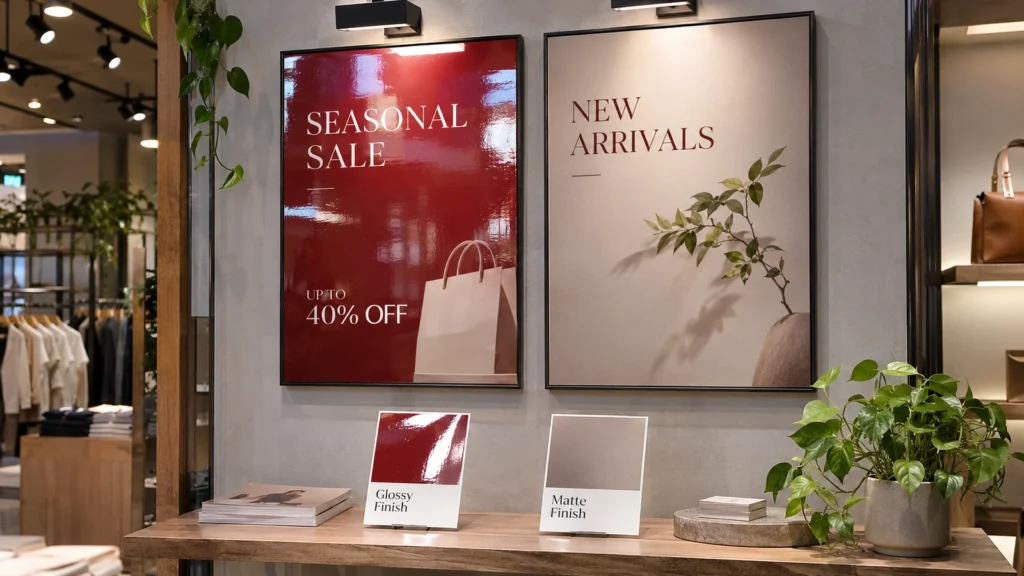
Seasonal Retail Posters: Paper Finish and Approval for Pop-Up Shops
A seasonal pop-up display may last just a few weeks, yet its posters need to communicate the offer correctly from opening day until takedown. Print finish affects glare, paper choice affects curling and the final layout must accommodate changing prices and store rules. This guide focuses on efficient seasonal production and approval rather than comparing poster materials in the abstract.
Write the message before choosing a print size
A short campaign message should contain the offer, scope and next action without making the customer decode crowded text. Identify legally or commercially necessary conditions and assign them a readable location. Avoid putting the most important statement at the very bottom where a shelf or display stand may cover it. The print size should follow where the customer stands.
For the purchase approval, test headline readability from the intended aisle distance using a paper mockup. This is worth recording before the design is signed off, because a visually loud design can hide the actual offer and trigger repeated staff questions.
Choose paper and finish to match installation
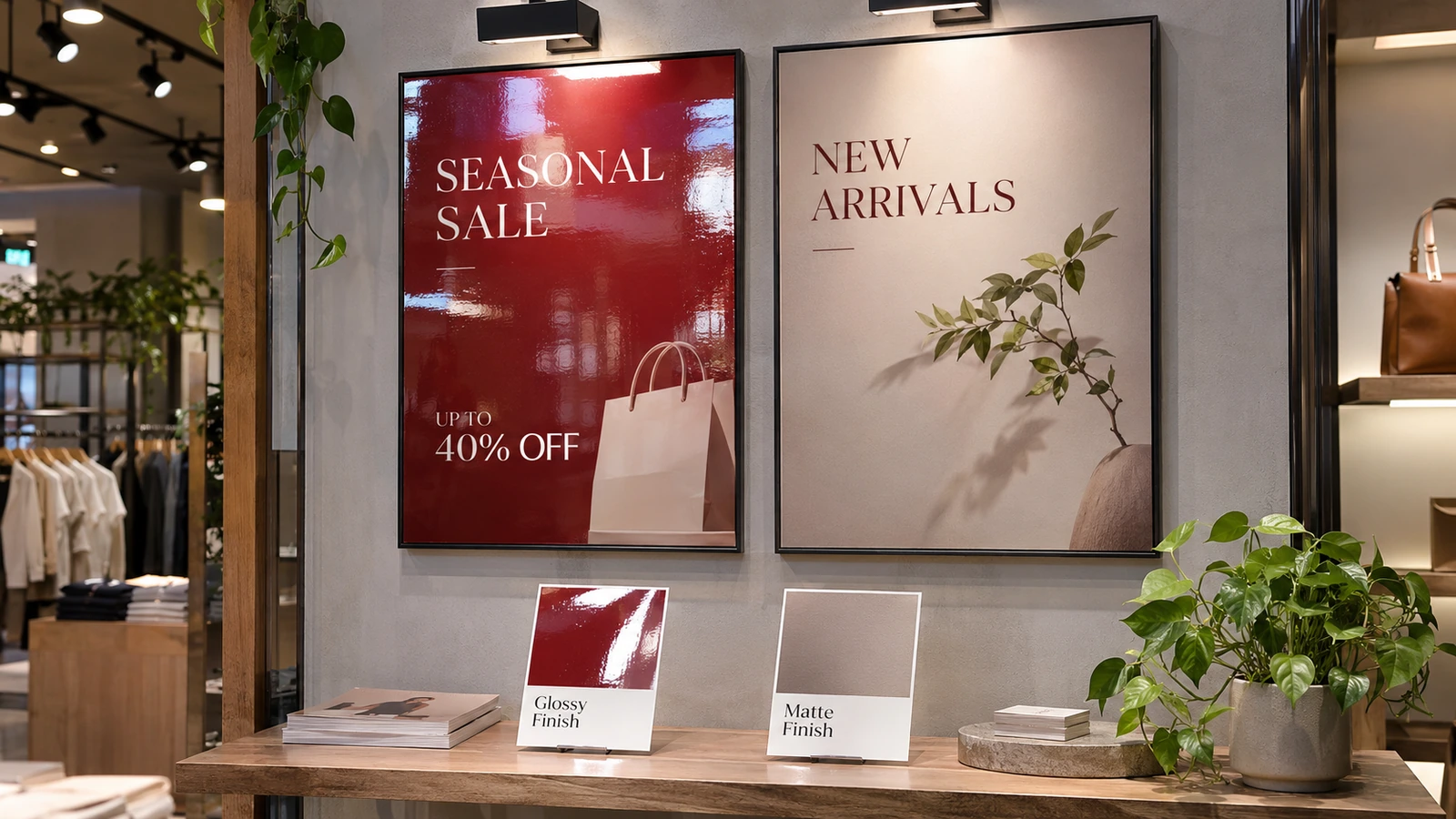
Wall-mounted posters, window displays and freestanding signs need different backing and finishes. A gloss surface can make colours appear vivid but may reflect direct lighting. Matte may be easier to read under spotlights, though its appearance depends on stock and inks. Select coating only after checking handling frequency and expected campaign duration.
A useful verification step is to hold physical samples at the planned location under retail lights. The practical reason for that check is that a finish approved on a desk can become unreadable opposite a bright window.
Allow for changeable prices and conditions
Seasonal campaigns often change before opening. Keep artwork elements editable and agree on a cut-off for revisions. If offers vary by branch, use separate named files rather than asking staff to alter printed prices with tape. Confirm that the approved artwork and checkout system use the same dates and promotional conditions.
During the production review, create a revision tracker with location, display format and final sign-off. Skipping this step can cause a surprisingly expensive problem: one older poster can contradict the actual register price and cause disputes.
Prevent damage during mounting
Poster edges can curl when the mounting method is unsuitable or the stock absorbs environmental moisture. A frame, clip rail or rigid board may help but changes the required safe margins. Keep small text away from edges likely to be hidden. Check whether the poster will be touched, wiped, rolled or stacked during delivery.
The team should also test one mounted proof and photograph all corners after a full trading day. Treat this as part of the specification rather than an informal preference, since a flat print can look untidy when adhesive, tape or frame pressure distorts it.
Coordinate multiple poster sizes
A campaign may use A3 posters, A4 counter notices and larger entry displays. Rather than scaling everything indiscriminately, preserve the same offer hierarchy while adjusting line breaks, visual emphasis and margins. Artwork exported at different sizes should be rechecked for tiny footnotes and cropped product photographs. Print-ready proof files need clear size suffixes.
Before a supplier prepares the final proof, review a physical or accurate full-size proof for each important size. The risk is operational as much as visual: shrinking one master design can make required terms impossible to read.
Prepare a branch-level installation list
List how many of each poster size should go to each outlet, who is responsible for installation and the date of removal. Pack prints flat or in suitable tubes as required, with protective separation for delicate finishes. Keep two approved copies for records and rapid replacement if the budget allows.
For a repeat order, send a short placement photo guide to employees before launch. Keep the result with the approved sample, since untracked leftovers can reappear after a campaign has already ended.
Practical example: making the decision
A temporary retail kiosk is preparing a two-week clearance promotion with entry posters and smaller notices beside products. The first layout looks attractive at A3 but becomes crowded when automatically reduced to A4. The designer keeps the same colours and headline, then rearranges the secondary information for the smaller format. A paper proof at the kiosk reveals severe glare on the gloss finish opposite a ceiling spotlight, while a matte sample remains easier to read. Staff verify that the prices, dates and exclusions match the point-of-sale settings. A version list identifies which poster belongs at each position and who will remove it after the final day. The supplier is instructed to pack the sizes separately, reducing setup confusion. The comparison is about operational fit, not a blanket claim that matte is always superior.
Additional approval considerations
Seasonal displays should be reviewed with the product shelves in place. A poster photographed against an empty wall may become hidden once stock stands, price tags and queue barriers appear. Walk the route a customer actually takes and note the moment they need the offer information. That route should determine where each format is installed.
If a poster contains an image of an item, check whether the item will really be available for the advertised period. A generic illustrative photograph can be helpful, but it should not mislead shoppers into expecting an unavailable colour or model. The marketing reviewer should approve the commercial meaning of the image as well as the technical print quality.
- Test headline readability from the intended aisle distance using a paper mockup.
- Hold physical samples at the planned location under retail lights.
- Create a revision tracker with location, display format and final sign-off.
- Test one mounted proof and photograph all corners after a full trading day.
- Review a physical or accurate full-size proof for each important size.
- Send a short placement photo guide to employees before launch.
An additional control is to test headline readability from the intended aisle distance using a paper mockup. Combine that check with a final handover step: send a short placement photo guide to employees before launch. Keep both results with the dated approval sample so a replacement order uses the same reference. Where the material, delivery address or production technique changes, ask for a fresh confirmation rather than assuming that an old quotation covers the new combination.
Frequently asked questions
Is gloss always better for colourful posters?
No. Glare under the actual lighting may outweigh stronger apparent gloss.
Should I laminate every short campaign poster?
Only if handling and cleaning justify the extra finish and cost.
Can one artwork scale to every poster format?
Use a common design system but recheck text and margins separately for each size.
What should be approved before printing?
Offer terms, final sizes, stock, finish, mounting method and revision number.
For a quotation based on the actual garment, print method, quantity and delivery location, review UniformPenang services and use the official enquiry page. Prices, methods, production schedules and minimum quantities must be confirmed for the specific job.