DTF Printing in Penang
Pros and Cons of DTF Heat Press Printing
DTF prints artwork onto transfer film before heat pressing it onto a garment. It is widely used for detailed logos, names, gradients and mixed-fabric shirt orders.
Direct answer: DTF is flexible, colourful and practical for small quantities, detailed artwork and personalised shirts. It can work on many compatible cotton, polyester and blended garments. Its drawbacks include a noticeable surface layer, reduced breathability under large prints, possible cracking or lifting from poor production or care, and less natural fabric feel than sublimation.
Detailed Colour
Supports gradients, fine lines and many colours.
Flexible Quantity
Useful for small runs and personalised pieces.
Surface Print Feel
Large designs may feel warmer or stiffer.

Quick comparison
DTF Advantages and Disadvantages
| Area | Advantages | Disadvantages |
|---|---|---|
| Artwork | Detailed, colourful and gradient-friendly | Tiny details can still lose clarity |
| Fabric | Works on many compatible cotton, polyester and blends | Heat-sensitive fabrics need testing |
| Quantity | Practical for small and personalised orders | Silkscreen may suit large simple orders better |
| Feel | Smooth and consistent surface graphic | Large solid prints can feel warm or stiff |
| Durability | Can last well with correct pressing and care | Poor adhesion may cause cracking or lifting |
| Dark shirts | White underbase keeps colours visible | Extra underbase increases thickness |
| Personalisation | Names, roles and numbers are easy to vary | Every detail must be checked carefully |
Best use: DTF works especially well for colourful artwork, mixed garment colours and smaller orders with variable names or numbers.

Suitable garments
Which Shirts Work Well With DTF?
Cotton T-Shirts
A popular choice for events, clubs, reunions and merchandise.
Quick-Dry Polyester
Suitable when heat settings and dye migration are controlled.
Cotton-Polyester Blends
A balanced base for everyday group shirts.
Heavyweight T-Shirts
Can support larger lifestyle graphics with careful sizing.
Polo Shirts
Compact logos work, although embroidery may look more premium.
Heat-Sensitive Garments
Require testing before pressing to avoid damage.
Garment rule: Confirm the exact shirt first. Fabric composition, colour, coating, stretch and heat sensitivity can affect the final result.

Method comparison
DTF vs Other Customisation Methods
DTF Printing
Best for detailed mixed orders, gradients and personalisation.
Silkscreen Printing
Best for larger quantities using simple repeated artwork.
Sublimation
Best for lightweight full-colour polyester jerseys.
Embroidery
Best for premium small logos on polos, jackets and caps.
DTG Printing
Useful for softer-feel artwork on compatible cotton.
Mixed Methods
Combine embroidery, DTF or heat transfer when useful.
Decision rule: Choose DTF when flexibility and detail matter more than the softest print feel or the lowest unit cost for a very large order.
Artwork and production guide
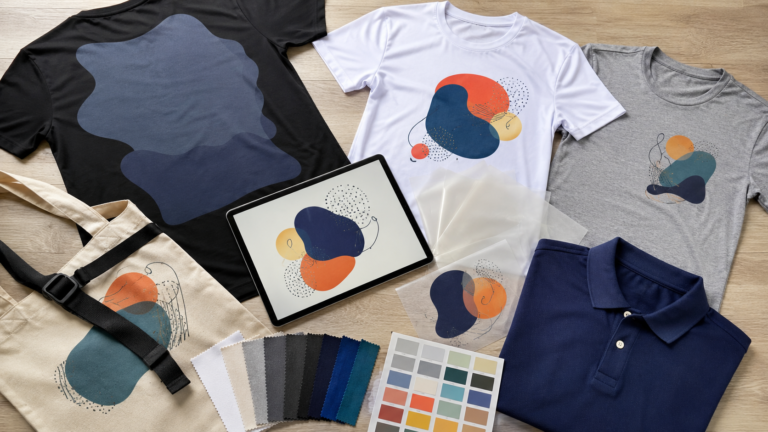
Six Factors That Affect DTF Quality
Artwork Resolution
Low-resolution files look blurry when enlarged.
White Underbase
A suitable underbase keeps colours visible on dark shirts.
Temperature
Incorrect heat can damage fabric or weaken adhesion.
Pressure and Time
Uneven pressing can cause lifting or incomplete bonding.
Print Coverage
Large solid designs can reduce airflow.
Garment Care
Gentle washing and no direct ironing help protect the transfer.
Common DTF Mistakes
- Using low-resolution artwork
- Making the design too large for smaller sizes
- Ignoring polyester dye migration
- Pressing heat-sensitive garments without testing
- Using large solid graphics on hot-weather shirts
- Ironing directly over the printed area
- Skipping a sample when placement matters

Ordering process
Order DTF-Printed Shirts Step by Step
Choose the Garment
Confirm the fabric, colour, model and size range.
Prepare the Artwork
Provide a high-resolution file with transparent background.
Confirm Print Size
Measure the actual width and height.
Check Shirt Colours
Review the artwork on light and dark garments.
Approve a Sample
Check colour, placement, feel and adhesion.
Confirm Personalisation
Review every name, number and size.
Keep the Reference
Store the approved artwork and measurements.
Buyer scenarios
When DTF Is the Better Choice
Use DTF
It supports multiple colours, gradients and fine details.
Use Variable DTF Transfers
Each shirt can use a different name, role or number.
Compare Silkscreen
Silkscreen may be more efficient for high quantities.
Compare Sublimation
Sublimation gives compatible polyester a lighter print feel.

Buyer checklist
Information to Prepare Before Ordering
- Exact garment model
- Fabric and shirt colour
- High-resolution artwork
- Print width and height
- Front, back or sleeve placement
- Names, roles or numbers
- Size breakdown
- Total quantity
- Packing instructions
- Required delivery date
Frequently asked questions
DTF Heat Press Printing FAQ
What does DTF mean?
DTF means direct to film. Artwork is printed onto transfer film and heat pressed onto the garment.
Can DTF print on cotton and polyester?
It can work on many compatible cotton, polyester and blended garments.
Does DTF feel thick?
Small designs can feel light, but large solid areas create a more noticeable layer.
Can DTF crack or peel?
It can happen when pressing, adhesion or garment care is poor.
Is DTF suitable for small quantities?
Yes. It is practical for small runs, mixed sizes and personalisation.
Can every shirt use the same print size?
No. Smaller sizes may need reduced artwork dimensions.
How should DTF shirts be washed?
Wash gently, avoid harsh heat and do not iron directly over the transfer.
Print detailed custom artwork
Request DTF Printing in Penang
Share the garment, quantity, sizes, artwork, print dimensions, placement and required date. Uniform Penang can help review whether DTF suits the design.
Useful Uniform Penang resources
Compare DTF With Other Methods
DTF Printing in Penang
Explore detailed multicolour printing.
Explore DTF →Silkscreen Printing
Compare larger simple orders.
Explore silkscreen →Sublimation Printing
Compare full-colour polyester jerseys.
Explore sublimation →Embroidery Guide
Compare compact stitched logos.
Open guide →Longest-Lasting Method
Compare print durability.
Open guide →Printing Care Guide
Learn how to wash printed shirts.
Open guide →Why Logos Crack or Peel
Learn causes and prevention.
Open guide →Contact Uniform Penang
Send the garment and artwork.
Go to contact →Our other company websites
Regional Apparel and Printing Support
JC Print Malaysia
Regional apparel and printing support.
Visit website →Selangor Print
Regional apparel and printing support.
Visit website →Uniform Johor
Regional apparel and printing support.
Visit website →Uniform Sabah
Regional apparel and printing support.
Visit website →Uniform Singapore
Regional apparel and printing support.
Visit website →Uniform Hub SG
Regional apparel and printing support.
Visit website →Tanah Studio
Regional apparel and printing support.
Visit website →KitaPrint
Regional apparel and printing support.
Visit website →Product ranges, stock, colours, delivery coverage and services may vary by region.