
Fabric Care Basics
Why Do Clothes Shrink After Washing?
Clothes can become shorter, narrower or tighter after washing because moisture, heat and movement allow fibres and yarns to relax from the tension created during fabric production. The amount of shrinkage depends on the fibre, fabric construction, finishing process and how the garment is washed and dried.
Direct answer: Clothes shrink when their fibres and yarns contract or relax after exposure to water, heat and mechanical action. Cotton T-shirts usually have a higher shrink risk than polyester T-shirts, while blended fabrics often sit somewhere in between. Hot washing and high-heat tumble drying can increase the risk, so the safest approach is to follow the care label and avoid more heat than the garment needs.
Fibre Type Matters
Cotton generally changes dimensions more readily than polyester, while blends vary with their fibre percentages and construction.
Heat Adds Stress
Hot water and high dryer temperatures can increase dimensional change in garments that are sensitive to heat.
Care Labels Come First
The label gives the manufacturer's recommended wash and drying conditions for that specific garment.

Quick comparison
What Makes a T-Shirt More Likely to Shrink?
| Factor | Typical shrink effect | Lower-risk approach |
|---|---|---|
| 100% cotton | Usually more prone to dimensional change than polyester | Use the care-label temperature and avoid unnecessary dryer heat |
| Polyester | Generally more dimensionally stable in normal laundering | Still avoid heat above the garment's care recommendation |
| Cotton-polyester blend | Often less shrink-prone than all-cotton, but results vary | Follow the label and treat according to the most sensitive component |
| Hot wash | Can increase fibre relaxation or heat-related dimensional change | Use cool or warm water when the care label allows |
| High-heat tumble dry | A common cause of noticeable size loss | Use lower heat or air dry when suitable |
| Heavy agitation | Can add mechanical stress and encourage relaxation | Choose an appropriate cycle rather than the harshest setting |
| Pre-shrunk garment | Designed to reduce later shrinkage, not guarantee zero shrinkage | Continue following the care instructions |
Useful rule: If fit is important, do not assume that a shirt will stay exactly the same size just because it is labelled pre-shrunk. Fabric composition, construction and laundering still matter.
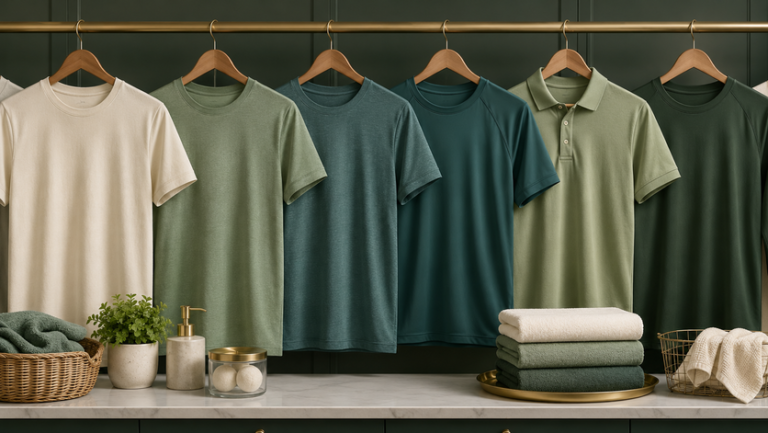
Fabric differences
How Different T-Shirt Fabrics React to Washing
100% Cotton T-Shirts
Cotton absorbs water readily and can relax after the tensions of spinning, knitting and finishing are released. If the garment is then exposed to excessive dryer heat, the size change can become more noticeable.
Polyester Quick-Dry T-Shirts
Polyester is usually more dimensionally stable than cotton during normal washing. However, high heat can still affect synthetic fibres, trims and printed decoration, so the care label remains important.
Cotton-Polyester Blends
Blends combine characteristics of both fibres. They often shrink less than equivalent all-cotton garments, but the exact behaviour depends on fibre ratio, knit construction and finishing.
Knitted T-Shirt Fabric
T-shirts are commonly made from knitted fabric, which has loops that can relax and change dimensions. Two shirts made from the same fibre can still shrink differently because their yarn, knit density and finishing are different.
Why Two Cotton T-Shirts Can Shrink Differently
Fibre content alone does not determine the result. Yarn type, fabric weight, knitting tension, dyeing, finishing, pre-shrinking and garment construction all influence dimensional stability.
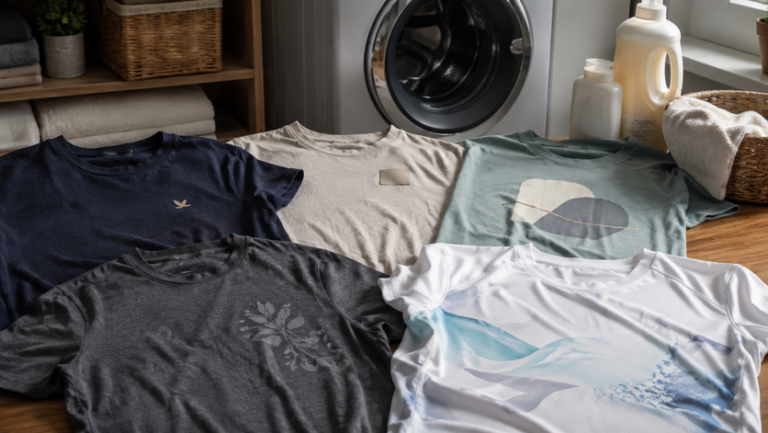
Printing and branding
What Shrinkage Can Do to Printed T-Shirts
Silkscreen Printing
If the fabric changes size, the printed area must move with it. Repeated high heat and aggressive washing can place extra stress on both the garment and the ink film.
DTF Transfers
A transfer sits on the garment surface. Excessive heat, stretching and fabric shrinkage can increase stress around the transfer, so washing inside out and following the supplier's instructions is recommended.
Sublimation Printing
Sublimation is commonly used on polyester garments. Because the design becomes part of the polyester surface rather than a separate film, there is no transfer layer to crack, although the garment should still be washed according to its label.
Embroidery
Embroidery itself may remain stable while the surrounding fabric changes dimension. If the base fabric shrinks noticeably, the embroidered area can look puckered or distorted.
Avoid Using Extra Heat to "Set" a Print at Home
Commercial decoration processes are applied under controlled conditions. After purchase, extra hot washing, ironing directly on decoration or excessive dryer heat can damage the garment or print instead of improving it.
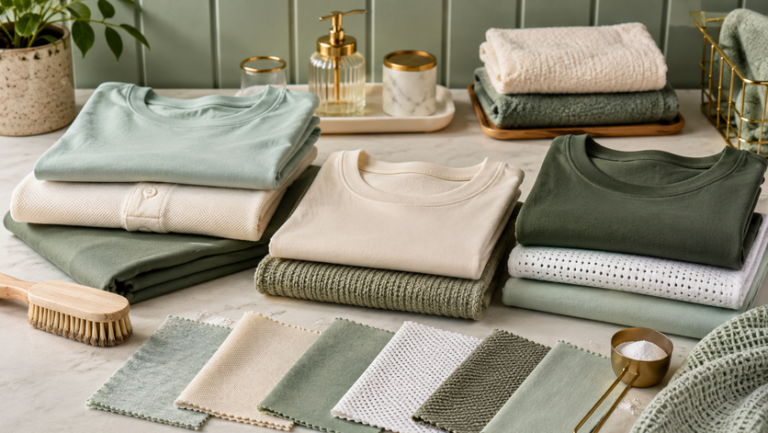
Why shrinkage happens
Water, Heat and Movement: The Three Main Triggers
Water
Water can swell moisture-absorbing fibres and allow yarns to move more freely. When the garment dries, the fabric may settle into a smaller relaxed form.
Heat
Heat speeds drying and can intensify dimensional change in heat-sensitive garments. Tumble drying is often where people notice the biggest size difference.
Agitation
Mechanical movement creates friction and encourages yarns to reposition. A harsh cycle is not always necessary for everyday T-shirts.
Relaxation Shrinkage
During manufacturing, fabric can be stretched or held under tension. Washing allows some of that tension to relax, so the garment becomes slightly shorter or narrower.
Residual Shrinkage
Pre-shrinking and finishing can reduce future size change, but a small amount may remain. That is why even well-finished garments can still change slightly after laundering.
Colour is not the main cause of shrinkage. A black T-shirt and a white T-shirt made from the same fabric can have similar shrink potential. Fibre type, construction, finishing and laundering conditions matter more.

Practical care steps
How to Reduce T-Shirt Shrinkage
Read the Care Label
Check the recommended wash temperature, cycle and drying method before the first wash.
Avoid Unnecessary Heat
Use cool or warm water when permitted and avoid choosing the hottest dryer setting by default.
Use an Appropriate Cycle
A normal or gentler cycle may be enough for everyday shirts. Heavy agitation is not always needed.
Dry More Gently
Air drying or lower-heat tumble drying can reduce heat exposure when those methods are suitable for the garment.
Reshape While Damp
For garments that permit it, gently smooth and reshape the shirt after washing rather than stretching it aggressively.
Test Team Uniforms Early
For large orders, wash one sample according to the intended routine before finalising sizing or issuing care instructions.
Common situations
When Shrinkage Matters Most
Consistent Sizing Across Staff
If uniforms are washed frequently, choose fabrics with suitable dimensional stability and give staff one clear care routine.
Children Between Sizes
Do not rely on expected shrinkage to create the right fit. Choose the correct current size and follow the garment's care instructions.
One-Off Shirts That Will Be Reused
A comfortable fit on event day is important, but so is how the shirt behaves later. Consider fabric composition when long-term reuse matters.
Frequent Washing and Drying
Quick-dry polyester is often practical for repeated sports use because it dries quickly and is generally dimensionally stable in normal care conditions.
Quick checklist
Do's and Don'ts for Reducing Shrinkage
Do
- Read the care label before washing
- Use an appropriate water temperature
- Choose lower dryer heat when suitable
- Turn decorated shirts inside out
- Reshape gently while damp if allowed
- Test a sample before large uniform rollouts
Avoid
- Assuming every cotton shirt shrinks the same amount
- Using the hottest wash for routine cleaning
- Drying every garment on maximum heat
- Stretching a wet shirt aggressively
- Ignoring print-specific care instructions
- Buying a larger size only because you expect shrinkage
Frequently asked questions
Clothes Shrinkage FAQ
Why does cotton shrink after washing?
Cotton fibres and knitted yarns can relax after being held under tension during manufacturing. Water, agitation and especially drying heat can make the dimensional change more noticeable.
Does polyester shrink in the washing machine?
Polyester is generally more dimensionally stable than cotton under normal laundering, but excessive heat can still affect polyester garments, trims and decoration.
Can cold water completely prevent shrinkage?
No. Lower temperatures can reduce heat exposure, but some relaxation may still occur because water and mechanical action also influence fabric dimensions.
Is the dryer more likely to shrink clothes than the washer?
High dryer heat is a common cause of noticeable shrinkage. However, the full laundering process matters, including water temperature, agitation, fabric type and drying method.
Do pre-shrunk T-shirts never shrink?
No. Pre-shrinking is intended to reduce future dimensional change, but it does not guarantee that the garment will remain exactly the same size after every wash.
Can a shrunken T-shirt be stretched back to size?
Sometimes a damp knitted garment can be gently reshaped, but there is no reliable way to restore every garment fully. Aggressive stretching can distort the shirt, seams or print.
Do printed T-shirts need different care?
Yes. In addition to protecting the fabric, you should follow the print supplier's care instructions. Turning the shirt inside out and avoiding excessive heat are commonly recommended precautions.
Should I size up because a T-shirt might shrink?
Not automatically. Choose the intended fit based on the garment's actual size chart and fabric information. Expected shrinkage is too variable to use as a sizing method.
Choose the right fabric for repeated wear
Need T-Shirts for Your Team or Event?
Uniform Penang can help you compare cotton, polyester and blended T-shirts together with suitable printing methods for company uniforms, schools, sports teams, events and group orders.
Useful Uniform Penang resources
More T-Shirt Washing and Care Information
Common T-Shirt Washing Mistakes
See the everyday habits that can affect fabric, fit, colour and decoration.
Open article →How to Wash White T-Shirts
Use a simple routine to reduce dullness, staining and colour transfer.
Open article →Can You Use Bleach on T-Shirts?
Learn when bleach may be suitable and when it may damage a garment.
Open article →DTF Printing
Explore colourful logo printing for company and event T-shirts.
Explore DTF →Silkscreen Printing
Compare a popular method for repeated logos and group orders.
Explore silkscreen →Contact Uniform Penang
Share your fabric, colour, quantity, artwork and required date.
Go to contact →Our other company websites
Regional Apparel and Printing Support
JC Print Malaysia
Regional apparel and printing support.
Visit website →Selangor Print
Regional apparel and printing support.
Visit website →Uniform Johor
Regional apparel and printing support.
Visit website →Uniform Sabah
Regional apparel and printing support.
Visit website →Uniform Singapore
Regional apparel and printing support.
Visit website →Uniform Hub SG
Regional apparel and printing support.
Visit website →Tanah Studio
Regional apparel and printing support.
Visit website →KitaPrint
Regional apparel and printing support.
Visit website →Product ranges, stock, colours, delivery coverage and service arrangements may vary by region.